
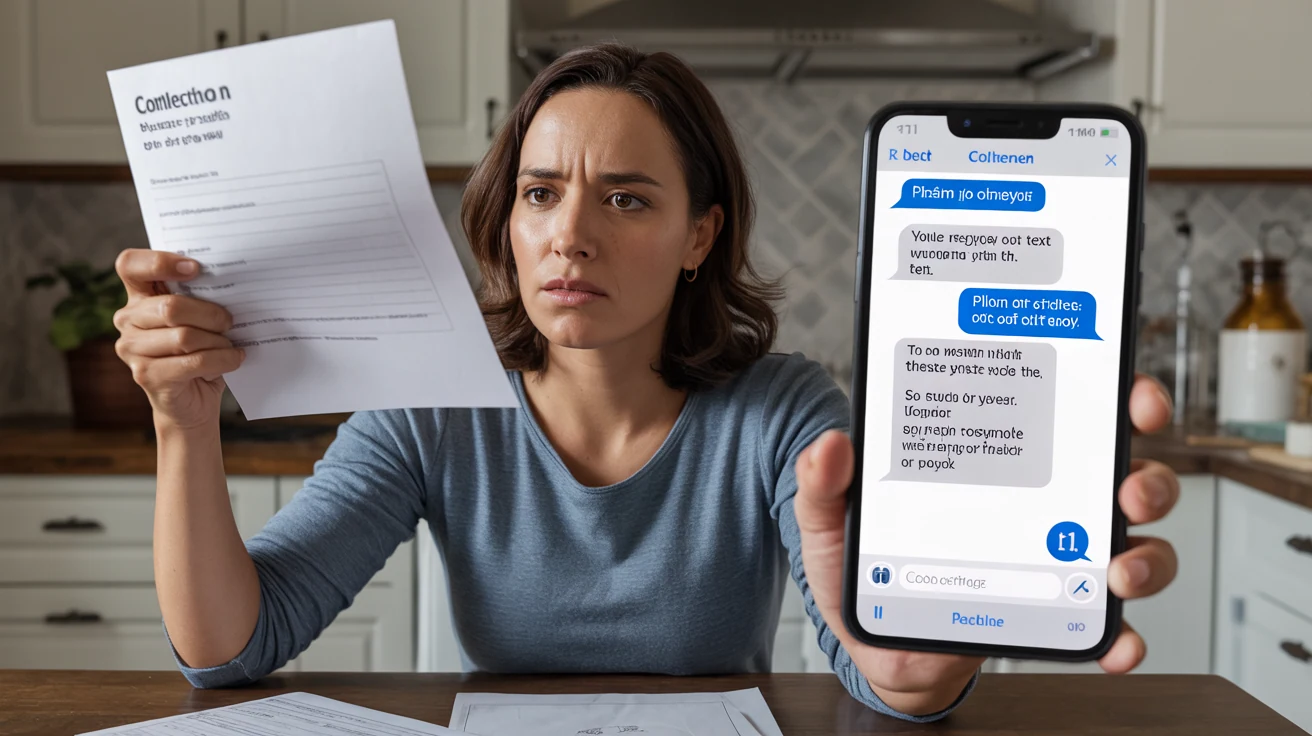
You told a debt collector to stop texting. Maybe you wrote, ‘stop texting me.’ Maybe you said, ‘do not contact me anymore,’ ‘leave me alone,’ or ‘only contact me by mail.’
Then a text came back telling you to ‘reply STOP’ to stop further messages. That follow-up text may be the legal problem, not just the collection texts that came before it.
If you are dealing with repeated collection texts, review your FDCPA rights and preserve the entire message thread immediately.
In This Guide
“Thank you for your response. If you do not wish to receive further messages, reply STOP to stop.”
Why the Follow-Up Text Can Be the Problem
Most consumers assume the only issue is the collection texts that came before they objected. Sometimes that is true. But the follow-up text can create a separate FDCPA issue.
Under 15 U.S.C. § 1692e(10), a debt collector may not use any false representation or deceptive means in connection with collecting a debt. If a consumer already sent a clear instruction to stop text messages, a response telling the consumer to take another keyword step may imply that the first message did not count.
That implication matters. It can make a consumer think the collector is free to keep texting until the consumer uses the collector’s preferred script. That is not what current CFPB guidance says.
What Regulation F Actually Says
The CFPB’s Debt Collection Rule requires debt collectors to include a clear and conspicuous opt-out notice in electronic communications. A text saying ‘reply STOP to stop texts to this number’ can be a reasonable and simple opt-out method under 12 C.F.R. § 1006.6(e).
But that does not mean STOP is the only legally effective opt-out. The CFPB’s Debt Collection Rule FAQ states that a consumer is not required to use the debt collector’s preferred or stated opt-out method, or the exact terms in the collector’s instructions. The FAQ also explains that words like ‘stop,’ ‘unsubscribe,’ ‘end,’ ‘quit,’ and ‘cancel’ generally count as opt-out requests even when they do not match the collector’s exact wording.
Regulation F separately provides that, once a person asks a debt collector not to use a communication medium, the collector generally must stop using that medium. See 12 C.F.R. § 1006.14(h)(1). And if a consumer opts out of electronic communications, the collector may send an electronic confirmation only if it contains nothing more than confirmation of the request and a statement that the collector will honor it. See 12 C.F.R. § 1006.14(h)(2)(i).
That narrow confirmation rule is important. A message that directs the consumer to take an extra step, instead of simply confirming the existing request and saying it will be honored, may fall outside that exception.
There is also a second layer to watch for. If the collector accepts incoming texts from consumers and the consumer’s message says ‘do not contact me anymore’ or otherwise demands no further communication, 12 C.F.R. § 1006.6(c)(1) may also come into play. Under that rule, an electronic cease-communication notice can be effective upon receipt when sent through a medium the collector accepts from consumers.
Why “Reply STOP” May Be Deceptive
The problem is not that STOP can never be offered as an opt-out method. The problem is what the follow-up text may communicate after the consumer has already opted out in plain language.
If you texted ‘stop texting me’ and the collector responded by telling you to ‘reply STOP,’ a consumer could reasonably understand that message to mean:
- the first opt-out did not work,
- the collector can keep texting until a magic word is used, or
- the consumer must follow the collector’s preferred script before the law protects them.
Those implications may be inaccurate under the CFPB’s current guidance. That is why the follow-up text may itself support a claim under 15 U.S.C. § 1692e(10).
If you are also dealing with repeated harassment, review Hyslip Legal’s article on how to stop debt collection harassment.
The Automation Problem
Collectors often send these messages through automation. A system may generate the same canned text after any inbound message, no matter what the consumer actually said.
That does not necessarily solve the collector’s problem. If the message is just a boilerplate autoresponse, it may fail to account for the consumer’s actual opt-out. If the collector argues the message was a real response to the consumer’s request, then the wording matters even more.
Either way, the collector still sent the text. If the text misleads the consumer about whether their opt-out already worked, or suggests an additional step is legally required, automation may explain the message but it does not automatically excuse it.
What Consumers Should Do Right Away
If this happened to you, take these steps immediately:
- Screenshot everything. Save the incoming texts, your reply, the autoresponse, the timestamps, and the phone number used.
- Do not delete the thread. Preserve the conversation exactly as it appears on the device.
- Do not assume you had to type STOP. The CFPB’s current guidance says a consumer does not have to use the collector’s exact preferred opt-out wording.
- Document any follow-up messages. If the collector kept texting after your instruction, that can strengthen the claim.
- Get a free case review. A consumer protection attorney can evaluate whether the response itself violated federal law.
If the collector is texting about a debt you dispute, you may also want to review Hyslip Legal’s article on the debt validation letter under the FDCPA.
Why This Matters
An illegal follow-up text is not just a technical problem. It can mislead a consumer into thinking they failed to protect themselves when the collector may be the party violating federal law.
In an individual FDCPA action, a successful consumer may recover up to $1,000 in statutory damages, plus actual damages where available, plus attorney’s fees and costs under 15 U.S.C. § 1692k.
That is why preserving the texts matters. The thread can show what you said, when you said it, and how the collector answered.
This information is for educational purposes only and does not constitute legal advice. Reading this page does not create an attorney-client relationship with Hyslip Legal, LLC. Every matter depends on its facts.